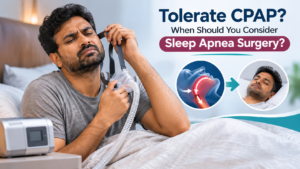




Do you remove your CPAP mask in the middle of the night because it feels uncomfortable? Are you struggling to sleep despite receiving treatment for obstructive sleep apnea?
Sleep apnea surgery may be considered when CPAP therapy remains difficult to tolerate despite appropriate adjustments, particularly when an identifiable airway obstruction contributes to breathing difficulties during sleep.
For individuals considering Sleep Apnea Surgery in Bangalore, identifying the location and cause of airway obstruction is an important step before choosing surgery.
(Prof.) Dr. Satish Nair, an ENT and Head & Neck Surgeon associated with Svastii, has a clinical background in managing ENT and head and neck disorders.
Why am I unable to sleep comfortably with my CPAP machine?
Continuous Positive Airway Pressure (CPAP) therapy keeps the airway open during sleep by delivering pressurised air through a mask. Although effective for many individuals, some patients struggle to use it consistently.
Common reasons for CPAP intolerance include:
-
Claustrophobia while wearing the mask.
-
Excessive air pressure or difficulty breathing out.
-
Persistent nasal congestion or blockage.
-
Dryness of the mouth, nose or throat.
-
Air leakage around the mask.
-
Abdominal bloating from swallowing air.
-
Skin irritation and disturbed sleep.
Sometimes, an underlying nasal obstruction, such as a deviated nasal septum or enlarged turbinates, can make CPAP use particularly uncomfortable.
Identifying the reason for intolerance is essential because some difficulties can be resolved without surgery.
What happens if I stop using CPAP because of discomfort?
Obstructive sleep apnea causes repeated narrowing or collapse of the upper airway during sleep. Stopping treatment without an appropriate alternative can allow breathing interruptions to return.
You may experience:
-
Loud and persistent snoring.
-
Waking up gasping or choking.
-
Morning headaches.
-
Excessive daytime sleepiness.
-
Difficulty concentrating.
-
Persistent fatigue despite adequate sleeping hours.
Untreated sleep apnea is also associated with an increased risk of hypertension, cardiovascular problems and stroke.
Rather than discontinuing treatment independently, discuss your difficulties with a sleep specialist to establish a suitable alternative treatment plan.
Are there any CPAP alternatives I should try before surgery?
Several CPAP alternatives may be considered depending on the severity of sleep apnea and its underlying cause.
| Treatment option | How it may help |
|---|---|
| Alternative CPAP masks | May improve comfort and reduce air leakage |
| APAP or selected bilevel PAP therapy | Provides different pressure delivery options |
| Mandibular advancement devices | Move the lower jaw forward to improve airway space |
| Positional therapy | Reduces airway obstruction in patients with position-dependent sleep apnea |
| Weight management | May reduce sleep apnea severity in individuals with excess weight |
| Nasal obstruction treatment | May improve nasal breathing and tolerance of CPAP |
Treating nasal allergies, adjusting humidification and reviewing pressure settings may also improve comfort.
The appropriate treatment depends on your sleep study findings, airway anatomy and general health.
When should I consider obstructive sleep apnea surgery?
Obstructive sleep apnea surgery may be considered when non-surgical treatment is unsuitable or remains difficult to tolerate despite reasonable attempts to improve adherence.
A surgical assessment may be appropriate if:
-
You have confirmed obstructive sleep apnea and cannot tolerate CPAP.
-
Enlarged tonsils or other anatomical abnormalities contribute to airway blockage.
-
Persistent nasal obstruction interferes with CPAP use.
-
Other suitable treatment options provide insufficient benefit.
Clinical guidelines from the American Academy of Sleep Medicine support discussing surgical referral with appropriately selected adults who cannot tolerate positive airway pressure therapy.
However, a surgical consultation does not necessarily mean that an operation is required.
What tests are needed before sleep apnea surgery?
A comprehensive evaluation helps determine whether surgery is appropriate and which part of the airway requires treatment.
-
Sleep study (polysomnography): Measures breathing interruptions, oxygen levels and sleep patterns.
-
Apnea-Hypopnea Index (AHI): Helps establish sleep apnea severity.
-
Nasal endoscopy: Identifies structural problems affecting nasal breathing.
-
Upper airway examination: Evaluates the tonsils, soft palate and tongue base.
-
Drug-induced sleep endoscopy (DISE): In selected patients, helps identify areas of airway collapse during a sleep-like state.
-
CPAP data review: Assesses mask leakage, usage patterns and treatment effectiveness.
These findings help develop an individualised treatment plan rather than selecting surgery based on snoring alone.
Which sleep apnea surgery is suitable for my condition?
There is no single surgical procedure suitable for everyone with sleep apnea. The choice depends on where the airway becomes obstructed.
-
Nasal surgery: Corrects selected nasal obstructions and may improve CPAP tolerance, although it may not resolve sleep apnea independently.
-
Tonsillectomy: May be appropriate when enlarged tonsils significantly restrict the airway.
-
Palatal surgery: Addresses obstruction involving the soft palate and surrounding throat tissues.
-
Tongue base surgery: May be considered when the tongue base contributes to airway collapse.
-
Maxillomandibular advancement: Repositions the upper and lower jaws to increase airway space in selected patients.
Surgical risks may include bleeding, infection, swallowing difficulties and persistent sleep apnea. Some patients may still require CPAP following surgery.
Patients with associated nasal or sinus conditions can learn more about endoscopic sinus surgery.
Should I seek a second opinion before undergoing sleep apnea surgery?
A sleep apnea surgery second opinion can help patients understand whether the recommended procedure addresses their specific airway obstruction.
Before making a decision, consider asking:
-
Have all reasonable non-surgical options been explored?
-
Where exactly is my airway collapsing?
-
Could surgery help me tolerate CPAP rather than replace it?
-
What are the potential risks and limitations?
-
Will I need another sleep study after surgery?
Bring your previous sleep study reports, CPAP usage records and medical history for a more comprehensive assessment.
When should I seek medical attention?
Seek medical evaluation if you regularly remove your CPAP mask during sleep, experience repeated nighttime choking or continue feeling excessively sleepy during the day.
Avoid driving if daytime sleepiness affects your alertness.
Seek emergency medical attention if you experience chest pain, fainting or severe breathing difficulties while awake.
Making an informed decision about sleep apnea surgery
Difficulty using CPAP does not mean you have exhausted all treatment options. Understanding the cause of intolerance and identifying the underlying airway obstruction can help guide further management.
(Prof.) Dr. Satish Nair, whose professional background in ENT and head and neck surgery is available on the Svastii website, has experience in evaluating ENT and airway-related conditions.
For patients considering Sleep Apnea Surgery in Bangalore, the treatment decision should be based on objective sleep assessments, anatomical findings, individual health conditions and realistic expectations.
Frequently Asked Questions (FAQs)
1. Can I undergo sleep apnea surgery if I cannot tolerate CPAP?
Yes. Selected patients with confirmed obstructive sleep apnea who cannot tolerate CPAP despite appropriate adjustments may be considered for surgical evaluation.
2. Will I still need CPAP after sleep apnea surgery?
Possibly. Some patients continue to require CPAP after surgery, sometimes at lower pressure settings. A follow-up sleep study helps determine whether ongoing treatment is necessary.
3. Can correcting a deviated nasal septum cure sleep apnea?
Septoplasty may improve nasal breathing and CPAP tolerance. However, it does not necessarily resolve sleep apnea because obstruction may also occur in other parts of the airway.
4. Is sleep apnea surgery suitable for severe sleep apnea?
Selected patients with severe sleep apnea may be considered for surgery. Eligibility depends on airway anatomy, sleep study findings, body weight and overall health.
5. Can sleep apnea return after surgery?
Yes. Sleep apnea may persist or recur due to weight changes, ageing or changes in airway anatomy. Regular follow-up and repeat sleep assessments may be necessary.
Medical disclaimer: This article is intended for patient education and does not replace individual medical assessment or treatment recommendations.