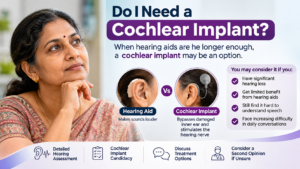



Hearing sounds but struggling to understand conversations can be frustrating, especially when you are already wearing hearing aids. If your hearing aids no longer provide sufficient speech clarity despite proper fitting and adjustment, a cochlear implant may be an appropriate treatment option.
However, not everyone experiencing difficulties with hearing aids requires surgery. A detailed hearing assessment is necessary to determine the underlying problem. For patients exploring Cochlear Implant Surgery in Bangalore, understanding the difference between amplification and auditory nerve stimulation is important.
(Prof.) Dr. Satish Nair, an ENT and Head & Neck Surgeon associated with Svastii, has a clinical and academic background in ear surgery and hearing-related disorders.
Why are my hearing aids suddenly not helping as much as before?
Hearing aids amplify sounds to make them more accessible. However, when the sensory hair cells inside the inner ear become severely damaged, increasing the volume may not necessarily improve speech understanding.
You might notice that:
-
People appear to be speaking unclearly.
-
Telephone conversations become increasingly difficult.
-
Following discussions in restaurants or family gatherings is exhausting.
-
You frequently ask people to repeat themselves.
-
Increasing the hearing aid volume makes sounds louder but not clearer.
-
You gradually avoid conversations and social activities.
These difficulties may indicate progressive hearing loss, inappropriate hearing aid settings, device malfunction, earwax accumulation or an underlying ear disorder.
Age-related changes, prolonged noise exposure, certain medications and genetic factors can also contribute to inner ear damage.
An updated hearing evaluation can help distinguish between a device-related problem and worsening hearing loss.
How do I know whether I qualify for a cochlear implant?
Cochlear implant candidacy depends on several clinical and functional factors rather than hearing loss severity alone.
An evaluation may be appropriate if you:
-
Have significant sensorineural hearing loss.
-
Struggle to understand speech despite appropriately fitted hearing aids.
-
Experience considerable communication difficulties in everyday life.
-
Receive limited benefit from conventional amplification.
Certain patients with significant hearing loss affecting only one ear may also qualify, depending on their individual circumstances.
Age alone does not determine eligibility. The condition of the inner ear, auditory nerve, general health and ability to participate in rehabilitation are important considerations.
The final decision is made following a comprehensive assessment by an ENT specialist and audiologist.
Hearing aids vs cochlear implants: What is the actual difference?
The fundamental difference between these devices is how they deliver sound information to the brain.
| Hearing aids | Cochlear implants |
|---|---|
| Amplify incoming sounds | Convert sounds into electrical signals |
| Depend on remaining inner ear function | Bypass damaged sensory hair cells |
| Generally do not require surgery | Require surgical implantation |
| Suitable for many degrees of hearing loss | Suitable for selected patients with significant hearing difficulties |
| Require fitting and periodic adjustments | Require programming and auditory rehabilitation |
A cochlear implant directly stimulates the auditory nerve through electrodes placed inside the cochlea.
However, it does not restore natural hearing. The brain needs time to adapt to the new sound signals, and individual outcomes vary.
EARS Program
What tests will determine whether my hearing aids are still suitable?
Before recommending an implant, the hearing care team may perform several assessments:
-
Pure-tone audiometry: Measures the softest sounds you can hear at different frequencies.
-
Speech recognition testing: Evaluates your ability to understand spoken words.
-
Aided speech testing: Measures speech understanding while wearing appropriately fitted hearing aids.
-
Tympanometry: Assesses eardrum movement and middle ear function.
-
Hearing aid verification: Checks whether your current devices provide appropriate amplification.
-
CT scan or MRI: When indicated, evaluates inner ear anatomy and auditory nerve integrity.
These findings help determine whether further hearing aid adjustments or another treatment approach would be appropriate.
What are my options for severe hearing loss treatment?
Severe hearing loss treatment depends on the type of hearing loss, its underlying cause and the benefit received from existing hearing devices.
Depending on the assessment, treatment options may include:
-
Reprogramming or replacing existing hearing aids.
-
Treating ear infections, earwax blockage or middle ear disorders.
-
Using assistive listening devices to improve communication.
-
Considering cochlear implantation when conventional hearing aids provide insufficient benefit.
-
Participating in auditory rehabilitation and communication training.
Patients with structural middle ear problems may require a different surgical approach. Learn more about the available ear surgery procedures.
What happens if I decide to undergo cochlear implant surgery?
During surgery, an internal receiver is positioned beneath the skin, and an electrode array is inserted into the cochlea.
Once the surgical area has healed sufficiently, the external sound processor is activated and programmed. Regular follow-up sessions help adjust the device according to the patient’s hearing responses.
Auditory rehabilitation is an important part of this process. Understanding speech with a cochlear implant may require practice and patience.
Potential surgical risks include infection, dizziness, changes in residual hearing and device-related complications. Recommended vaccinations and individual surgical risks should also be discussed before the procedure.
Should I get a second opinion before choosing a cochlear implant?
Seeking a cochlear implant second opinion can be helpful if you are uncertain about undergoing surgery or have received conflicting recommendations.
During a second-opinion assessment, consider asking:
-
Have my current hearing aids been optimally adjusted?
-
What do my speech recognition scores indicate?
-
Are there any non-surgical alternatives?
-
What level of hearing improvement can I realistically expect?
-
Will I require long-term auditory rehabilitation?
Bring your previous audiograms, hearing aid programming records and relevant medical reports. These can help the specialist understand how your hearing has changed over time and whether implantation is appropriate.
When should I seek medical attention for worsening hearing?
Arrange an ENT and audiology assessment if your hearing gradually deteriorates or communication becomes increasingly difficult despite using hearing aids.
Seek immediate medical attention if you experience sudden hearing loss developing within hours or three days, particularly when accompanied by ringing in the ear, dizziness or ear fullness.
Sudden hearing loss can be a medical emergency, even when there is no ear pain. Early assessment is important because certain treatments are time-sensitive.
Making an informed decision about your hearing
The decision to move from hearing aids to a cochlear implant should be based on clinical findings, everyday communication needs and realistic expectations.
The information available through Svastii and the professional background of (Prof.) Dr. Satish Nair provide context for understanding ear-related conditions and surgical treatment options.
For individuals considering Cochlear Implant Surgery in Bangalore, a comprehensive hearing evaluation and an informed discussion about benefits, limitations and rehabilitation requirements are essential before making a treatment decision.
Frequently Asked Questions (FAQs)
1. Can a cochlear implant help if hearing aids are no longer effective?
Yes. Selected individuals with significant sensorineural hearing loss and limited speech understanding despite properly fitted hearing aids may benefit from cochlear implantation.
2. Am I too old to receive a cochlear implant?
There is no universal upper age limit. Eligibility depends on general health, hearing assessment results, surgical suitability and rehabilitation requirements.
3. Will I hear normally immediately after cochlear implant surgery?
No. The device is activated after an appropriate healing period. Learning to interpret sounds requires programming, rehabilitation and practice.
4. Can I wear a hearing aid in one ear and a cochlear implant in the other?
Yes. This approach is known as bimodal hearing and may be suitable for individuals who continue to receive useful hearing aid benefit in the opposite ear.
5. Can a more powerful hearing aid replace the need for a cochlear implant?
Sometimes, adjusting or upgrading hearing aids may help. However, greater amplification may not improve speech clarity when inner ear damage is extensive. Aided speech testing helps determine the appropriate approach.
Medical disclaimer: This article is intended for patient education and does not replace an individual medical assessment, diagnosis or treatment recommendation.